Archive

Posts Tagged ‘Karima Nigmatulina’

Newsweek

April 19th, 2010 Nick Vu No comments

We’ve been seeing more and more visitors from the media around here. The most recent journalist to peruse the lab was Newsweek’s Dan Lyons, who was looking for the lowdown on our malaria work. Although the Photonic Fence, a.k.a. the mosquito laser system, has gotten most of the press lately due to Nathan Myhrvold’s TED talk, we have several other malaria projects that are starting to turn heads as well.

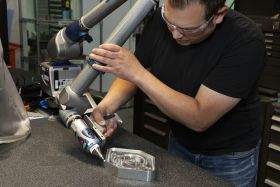
The meat of the article follows Karima Nigmatulina, Ph.D. and Philip Eckhoff, Ph.D. (pictured above) and their disease modeling software. A few other projects got shout-outs as well. These include malaria detection tools headed by Michael Hegg, Ph.D. and Ben Wilson Ph.D. (pictured below), the artificial mosquito diet of Barcin Acar Ph.D. and Emma Mullen, and of course 3ric Johanson’s Photonic Fence. Even TerraPower managed to sneak in there.

Dan was a machine, bolting from group to group and scrawling endless notes in the process; we watched him fill up three whole pads of paper! The result is “Short-Circuiting Malaria,” which can be found on Newsweek‘s website and will be in print any day now. We appreciate the coverage and are excited that more of our projects are being recognized.

Check out the Newsweek article here.

Epidemiological Modeling

February 23rd, 2010 Nick Vu No comments

In our efforts to fight malaria, the Photonic Fence has been getting all the attention lately, but this is just one of several ideas that we are actively working on to combat disease.  Another key malaria project is Epidemiological Modeling.  This is a highly detailed computer simulation that predicts how the disease spreads at local, regional and global scales.  The model takes into account many variables that affect transmission such as temperature, population, transportation, and the use of vaccines, bed nets and even innovations such as the Photonic Fence.

There are a wide variety of epidemiological modeling approaches that many groups use to study malaria. Ultimately, our work and other existing approaches are used to evaluate and predict effective strategies for malaria eradication.

Mathematician, Philip Eckhoff, and computational scientist, Karima Nigmatulina, explain the project and software.