Archive

Posts Tagged ‘Philip Eckhoff’

Newsweek

April 19th, 2010 Nick Vu No comments

We’ve been seeing more and more visitors from the media around here. The most recent journalist to peruse the lab was Newsweek’s Dan Lyons, who was looking for the lowdown on our malaria work. Although the Photonic Fence, a.k.a. the mosquito laser system, has gotten most of the press lately due to Nathan Myhrvold’s TED talk, we have several other malaria projects that are starting to turn heads as well.

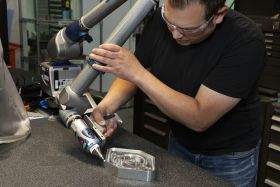
The meat of the article follows Karima Nigmatulina, Ph.D. and Philip Eckhoff, Ph.D. (pictured above) and their disease modeling software. A few other projects got shout-outs as well. These include malaria detection tools headed by Michael Hegg, Ph.D. and Ben Wilson Ph.D. (pictured below), the artificial mosquito diet of Barcin Acar Ph.D. and Emma Mullen, and of course 3ric Johanson’s Photonic Fence. Even TerraPower managed to sneak in there.

Dan was a machine, bolting from group to group and scrawling endless notes in the process; we watched him fill up three whole pads of paper! The result is “Short-Circuiting Malaria,” which can be found on Newsweek‘s website and will be in print any day now. We appreciate the coverage and are excited that more of our projects are being recognized.

Check out the Newsweek article here.

Philip Eckhoff recognized by Hertz Foundation

February 25th, 2010 Nick Vu No comments

HertzOn January 14, 2010, Philip Eckhoff was honored by the Hertz Foundation.  He was nominated for contributions in the field of disease eradication modeling, which he worked on in his spare time while completing his doctorate at Princeton.  The prize is not regularly awarded, but offered only in the midst of noteworthy accomplishment related to applied science and engineering.  Jay Davis, the foundation’s president, presented a certificate of recognition.  Also expressing words of acknowledgment and appreciation were the foundation’s chairman, David Galas,  funder of the epidemiological modeling project, Bill Gates, and Intellectual Ventures CEO, Nathan Myhrvold.

The Hertz Foundation inducts some 15 promising grad students as fellows each year.  Generous thesis funding and support have made the Hertz Fellowship one of the most sought after and prestigious award of its kind.  In 2004, Philip successfully underwent the rigorous application and interview process that would jumpstart his Ph.D. research in Applied and Computational Mathematics.  The foundation also continues to recognize outstanding accomplishments of its alumni, for which was the purpose of this event.

Philip has been hard at work with a team at Intellectual Ventures Lab developing an original computer model that calculates how malaria spreads, as well as how it responds to various methods of suppression. The goal of this ambitious and unprecedented model is not just to understand and control the disease but to stamp it out completely.

Although the software tool can be readily expanded to simulate infectious diseases beyond malaria, enough laboratory and epidemiological data is not available in some cases to create a truly reliable eradication model today. However, our infectious disease model is an exciting step toward providing a tool for both greater understanding and more effective action against these diseases, and hope for a healthier humanity.

We are proud of Philip’s ground breaking work, congratulate him on receiving this high honor and offer him the best of luck in his continued research.

Epidemiological Modeling

February 23rd, 2010 Nick Vu No comments

In our efforts to fight malaria, the Photonic Fence has been getting all the attention lately, but this is just one of several ideas that we are actively working on to combat disease.  Another key malaria project is Epidemiological Modeling.  This is a highly detailed computer simulation that predicts how the disease spreads at local, regional and global scales.  The model takes into account many variables that affect transmission such as temperature, population, transportation, and the use of vaccines, bed nets and even innovations such as the Photonic Fence.

There are a wide variety of epidemiological modeling approaches that many groups use to study malaria. Ultimately, our work and other existing approaches are used to evaluate and predict effective strategies for malaria eradication.

Mathematician, Philip Eckhoff, and computational scientist, Karima Nigmatulina, explain the project and software.

Software Modeling to Help Eradicate Infectious Diseases

February 11th, 2010 Pablos 1 comment

Modeling the Eradication of Malaria

Despite decades of attempts to control malaria, the disease still afflicts some 250 million people every year and claims the lives of about one million, mostly children. The parasite that causes malaria has shown stubborn resilience against the most power­ful antimalarial drugs, and the mosquitoes that transmit the parasite have similarly grown resistant to insecticides. Although there is great hope for an effective vaccine, none is yet available.

At Intellectual Ventures, we believe history shows that trying to control malaria is an insufficiently ambitious goal. We in the scientific and technical community should instead develop tech­nologies and strategies that can be used to completely eradicate the disease. Much of the progress we make toward eliminating malaria will also be directly useful in exterminating other infec­tious plagues of humanity, such as polio and tuberculosis.

Toward this goal, a team led by Dr. Philip Eckhoff is de­veloping a completely original computer model that calculates not only how malaria spreads in a particular part of the world, but also how it will respond to a deliberate suppression cam­paign. The goal of this model, more ambitious than any similar software ever attempted before, is not just to understand and control the disease, but to stamp it out completely.

map

Read more…