We’ve been seeing more and more visitors from the media around here. The most recent journalist to peruse the lab was Newsweek’s Dan Lyons, who was looking for the lowdown on our malaria work. Although the Photonic Fence, a.k.a. the mosquito laser system, has gotten most of the press lately due to Nathan Myhrvold’s TED talk, we have several other malaria projects that are starting to turn heads as well.
The meat of the article follows Karima Nigmatulina,
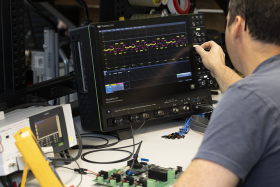
Ph.D. and Philip Eckhoff, Ph.D. (pictured above) and their disease modeling software. A few other projects got shout-outs as well. These include malaria detection tools headed by Michael Hegg, Ph.D. and Ben Wilson Ph.D. (pictured below), the artificial mosquito diet of Barcin Acar Ph.D. and Emma Mullen, and of course 3ric Johanson’s Photonic Fence. Even TerraPower managed to sneak in there.
Dan was a machine, bolting from group to group and scrawling endless notes in the process; we watched him fill up three whole pads of paper! The result is “Short-Circuiting Malaria,” which can be found on Newsweek‘s website and will be in print any day now. We appreciate the coverage and are excited that more of our projects are being recognized.
Check out the Newsweek article here.
Tags: 3ric Johanson, Barcin Acar, Ben Wilson, Dan Lyons, Emma Mullen, Epidemiological Modeling, Hemozoin Detection, Karima Nigmatulina, Malaria, Michael Hegg, Mosquitoes, Newsweek, Philip Eckhoff, Photonic Fence, TerraPower
Our hard work has created quite a buzz. We are still exploring options for aspects of the TWR technology, but want to acknowledge all the interest generated from recent media coverage.
The reality is that we are sharing information about our Traveling-Wave Reactor (TWR) design with a variety of U.S. and international organizations and governments to listen, learn and discuss future options for the design. But we have not entered into agreements with any companies to build or operate the TWR at this time.
The Traveling Wave Reactor design is still in the research and development (R&D) phase. Today’s energy and climate problems require more R&D than any one nation can provide. We cannot succeed without collaborative technology development. That’s why TerraPower researchers are learning from demonstrated technologies and best engineering practices worldwide. To be clear, the TerraPower team’s information sharing complies with U.S. regulation.
We’re excited to see enthusiasm for the prospects of our technology. As the R&D effort progresses, we’ll be posting our relevant results here on the blog.
To read our full statement, take a look at the pdf.
TerraPower’s university collaborations contribute meaningful progress to the design of the traveling wave reactor. We’ve been proactive about introducing future generations of nuclear engineers and scientists to new advanced reactor technology, but this work is appealing to young computer science students as well. In November, Craig Mundie, Microsoft’s chief research and strategy officer, visited four college campuses to talk with students about how new capabilities in computers will help solve the world’s complex issues. Mundie showcased the cutting-edge work taking place at Microsoft as well as some of TerraPower’s modeling work.
Mundie offered computer science students some insight into what the future of scientific research might look like. At the Intellectual Ventures Lab, we are shaping that vision.

The evolution of computing impacts our ability to solve some the most complex issues facing the world. TerraPower’s modeling software is one example. Used to develop the traveling-wave concept, this software, has cut the time required to complete high-fidelity nuclear engineering calculations by several orders of magnitude. These computational analyses have enabled TerraPower to design a practical traveling-wave reactor which provides a new basis for innovation in nuclear energy.
Today Bill Gates talked about our nuclear reactor project, TerraPower, at TED 2010. As an investor in several promising energy projects, Gates said it is our responsibility to pursue technologies that achieve cheap energy with “zero carbon” emissions.
TerraPower determined a new type of traveling-wave reactor would be the best approach to meeting the world’s energy demand. Our team decided to pursue nuclear energy after investigating many different technologies and solutions. With advances in computing power in just the past few years, we are able to make radical contributions to science that weren’t possible a few years ago. We believe the traveling-wave reactor concept provides the kind of innovation that society needs.
This video explains the traveling-wave reactor and how it works.

TerraPower is making great progress on their nuclear reactor design by using supercomputing clusters for computational modeling work. A calculation that takes all day to run on a desktop computer can run in one minute on our cluster.

This past year, the TerraPower team has been heavily involved in engineering work and design with a confidence and speed that would not be possible without the use of a computing cluster. Rigorous modeling techniques present intricate insight into the physics of the online cultivation of fuel, that enables the unique fuel cycle of the Traveling Wave Reactor. Extensive computer simulations and engineering studies produced new evidence that a wave of fission moving slowly through a fuel core could generate a billion watts of electricity continuously for well over 50 to 100 years without enrichment or reprocessing. The hi-fidelity results made possible by advanced computational abilities of modern supercomputer clusters are the driving force behind one of the most active nuclear reactor design teams in the country. Read more…
TerraPower has been selected by the MIT Technology Review as one of its “10 Emerging Technologies 2009.” The team continues to work on their reactor design to one day bring it to market. We have done a bit of support for this project here in the lab, creating mockups of the reactor components in the machine shop.
Here’s a diagram and a video of John Gilleland describing how this “traveling wave reactor” works.
Read more…
This animation shows how our traveling wave reactor design works. Once started, a steady-state wave of power propagates through the reactor core. The power wave contains two different waves which “breed” (make fuel) and “burn” (use fuel). This process turns depleted uranium waste into fuel.

This is a photo of an existing stockpile of depleted uranium at Paducah, Kentucky. The U.S. has 700,000 metric tons of this nuclear waste. Using this as fuel for our reactor, it represents a 3000 year national energy reserve.
Traveling Wave Reactors can convert these 36,000 cylinders of “waste” to ~$100 Trillion of electricity.

Photo: Peter Essick
Learn more from The Depleted UF6 Management Information Network.