TerraPower’s university collaborations contribute meaningful progress to the design of the traveling wave reactor. We’ve been proactive about introducing future generations of nuclear engineers and scientists to new advanced reactor technology, but this work is appealing to young computer science students as well. In November, Craig Mundie, Microsoft’s chief research and strategy officer, visited four college campuses to talk with students about how new capabilities in computers will help solve the world’s complex issues. Mundie showcased the cutting-edge work taking place at Microsoft as well as some of TerraPower’s modeling work.
Mundie offered computer science students some insight into what the future of scientific research might look like. At the Intellectual Ventures Lab, we are shaping that vision.

The evolution of computing impacts our ability to solve some the most complex issues facing the world. TerraPower’s modeling software is one example. Used to develop the traveling-wave concept, this software, has cut the time required to complete high-fidelity nuclear engineering calculations by several orders of magnitude. These computational analyses have enabled TerraPower to design a practical traveling-wave reactor which provides a new basis for innovation in nuclear energy.
Today Bill Gates talked about our nuclear reactor project, TerraPower, at TED 2010. As an investor in several promising energy projects, Gates said it is our responsibility to pursue technologies that achieve cheap energy with “zero carbon” emissions.
TerraPower determined a new type of traveling-wave reactor would be the best approach to meeting the world’s energy demand. Our team decided to pursue nuclear energy after investigating many different technologies and solutions. With advances in computing power in just the past few years, we are able to make radical contributions to science that weren’t possible a few years ago. We believe the traveling-wave reactor concept provides the kind of innovation that society needs.
This video explains the traveling-wave reactor and how it works.

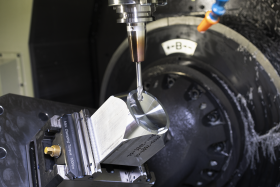
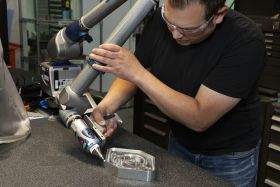
TerraPower has been selected by the MIT Technology Review as one of its “10 Emerging Technologies 2009.” The team continues to work on their reactor design to one day bring it to market. We have done a bit of support for this project here in the lab, creating mockups of the reactor components in the machine shop.
Here’s a diagram and a video of John Gilleland describing how this “traveling wave reactor” works.
Read more…
This animation shows how our traveling wave reactor design works. Once started, a steady-state wave of power propagates through the reactor core. The power wave contains two different waves which “breed” (make fuel) and “burn” (use fuel). This process turns depleted uranium waste into fuel.

This is a photo of an existing stockpile of depleted uranium at Paducah, Kentucky. The U.S. has 700,000 metric tons of this nuclear waste. Using this as fuel for our reactor, it represents a 3000 year national energy reserve.
Traveling Wave Reactors can convert these 36,000 cylinders of “waste” to ~$100 Trillion of electricity.

Photo: Peter Essick
Learn more from The Depleted UF6 Management Information Network.